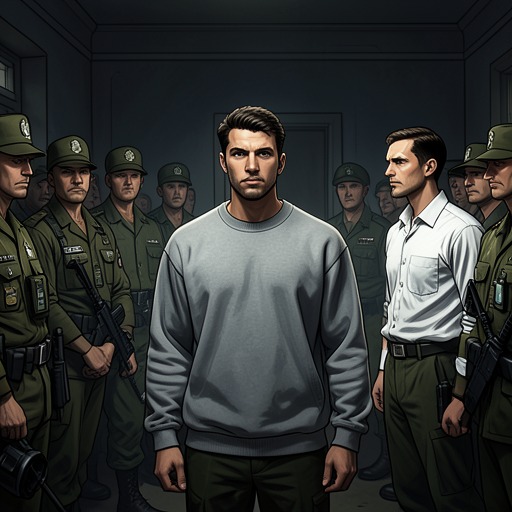
Slahi's 2003 special interrogation and abuse at Guantánamo
Guantanamo DiarySlahi's 2003 special interrogation and abuse at Guantánamo was a planned campaign of coercive questioning that escalated from prolonged sleep deprivation and isolation to physical abuse and staged deception. His account describes what happened to him; later records summarized by government investigations corroborated important parts of it, while redactions and the limits of public documentation leave other details uncertain.
Background and authorization
When a military C-17 brought Slahi and thirty-four other prisoners to Guantánamo Bay detention camp on August 5, 2002, available reporting did not identify him as an especially high-value detainee. The camp’s roughly six hundred prisoners were described as not high enough in al-Qaeda’s command structure to help unravel its organization. As military leaders and investigators disputed interrogation methods, however, the camp’s approach changed. A Special Projects Team was established, and the methods later used on Slahi belonged to a wider shift toward specially designed interrogations.
The authorization trail for Slahi’s Special Interrogation Plan is documented in later reviews. General Geoffrey Miller submitted the plan to General James Hill on July 18, 2003; Hill forwarded it to Secretary of Defense Donald Rumsfeld on July 28; Deputy Secretary of Defense Paul Wolfowitz approved it on July 28, and Rumsfeld signed it on August 13. A separate account of the plan’s development says it was approved at the highest levels of the military chain of command. The chronology places the plan within an institutional process, rather than presenting the abuse as an isolated improvisation by one interrogator.
Methods and escalation
In Slahi’s account, one interrogator, whom the manuscript names only through redactions, kept him awake for about two months while attempting to weaken his resistance. The methods described included lowering the room temperature, making him write about his life, repeatedly giving him water, and requiring him to remain standing for extended periods. The interrogator also used humiliating treatment. These measures were not presented as separate incidents: together, they made sleep and ordinary control of his surroundings conditional on the interrogators’ demands.
The setting extended beyond the questioning of Slahi alone. He could tell from activity around him that the same interrogator was handling other detainees. His account describes music and images used in interrogation rooms, and says that Islamic practices, including prayer, were forbidden. It also recalls repeated playing of the United States national anthem and a picture of George W. Bush in a cold room. Such details connect the personal account to the wider use of sensory and religious pressure, while the manuscript’s redactions prevent the identities of several people and locations from being established with certainty.
Slahi describes a further escalation after the team concluded that he was not cooperating as it wished. A group entered the interrogation room, and he was assaulted before being handed to Arabic-speaking interrogators, identified in his account as Egyptian and Jordanian. They continued the abuse and used ice. After several hours, he was returned to his cell. The memoir records the episode from his perspective; the available evidence does not establish every person’s identity or resolve every redacted circumstance.
Deception, isolation, and corroboration
The plan also used deception to make Slahi believe that he had been taken away from the island and that the rules governing his detention had changed. Investigative summaries describe a staged transfer: on August 25, 2003, he was removed from his cell in Camp Delta wearing blackout goggles and taken on a disorienting boat ride. The plan had called for a helicopter, but investigators reported that this was abandoned as too difficult to arrange. The subsequent destination was Camp Echo, where his cell and interrogation room were designed to minimize outside stimulation. Preparations included sealing the space against light and preventing visual contact with guards.
Other documentary evidence helps establish the context for Slahi’s account without making every redacted detail recoverable. A fictitious letter drafted by the interrogation team claimed that his mother had been detained and might be transferred to Guantánamo if she did not cooperate. The Senate Armed Services Committee later described the letter as an attempt to exploit his relationship with her. An October 17, 2003, email exchange between an interrogator and a military psychiatrist recorded Slahi reporting that he was hearing voices; the psychiatrist noted that sensory deprivation can cause hallucinations. These records give independent documentary support to the presence of psychological pressure and its effects.
A Naval Criminal Investigative Service investigator assigned to Stuart Couch gained access to the interrogators’ files, including daily memoranda that recorded both what was said and how information was obtained. Those files remained classified. Their contents were later summarized in the Senate Armed Services Committee’s 2008 inquiry and a 2008 review by the U.S. Department of Justice. The summaries describe a special interrogation that followed a second, detailed plan and broadly matched Slahi’s account. They support key elements of his description, but they are not a public release of the full records.
Aftermath and the limits of the record
Slahi says doctors were allowed to see him around March 2004 and that he first received psychological assistance the following month. He reports being prescribed medication for depression and sleep, as well as a multivitamin for a condition attributed to lack of sunlight. Although he received some psychological assessment, he says fear of retaliation prevented him from telling the clinicians the real reason for his condition. In this way, the effects of the interrogation continued into the period when treatment became available, while the conditions of his confinement also limited what he felt able to disclose.
The published account is surrounded by a second, explicitly qualified layer of evidence: editorial annotations that use the manuscript’s context, other passages, public records, declassified documents, and investigative reporting to make sense of redactions. The editor stated that these notes do not attempt to reconstruct the original censored text or uncover classified material, and that the speculations had not been confirmed by anyone with access to the unredacted manuscript. The distinction matters. The account and later official summaries substantiate significant features of the interrogation, but black bars still obscure names, details, and sometimes the sequence of events. The episode thus exposes not only the coercive methods used against Slahi, but also the limits imposed on the public record by continuing secrecy.